Some places aren’t found on maps.
They’re made in the in-between moments — in the grocery store aisle where you pause to smell the lemons, at the corner of a street you’ve walked a thousand times, or on an old family chair that creaks like it remembers you.
LALATOWN didn’t come from a perfect life or a beautiful, uninterrupted stretch of happiness.
It grew out of the cracks.
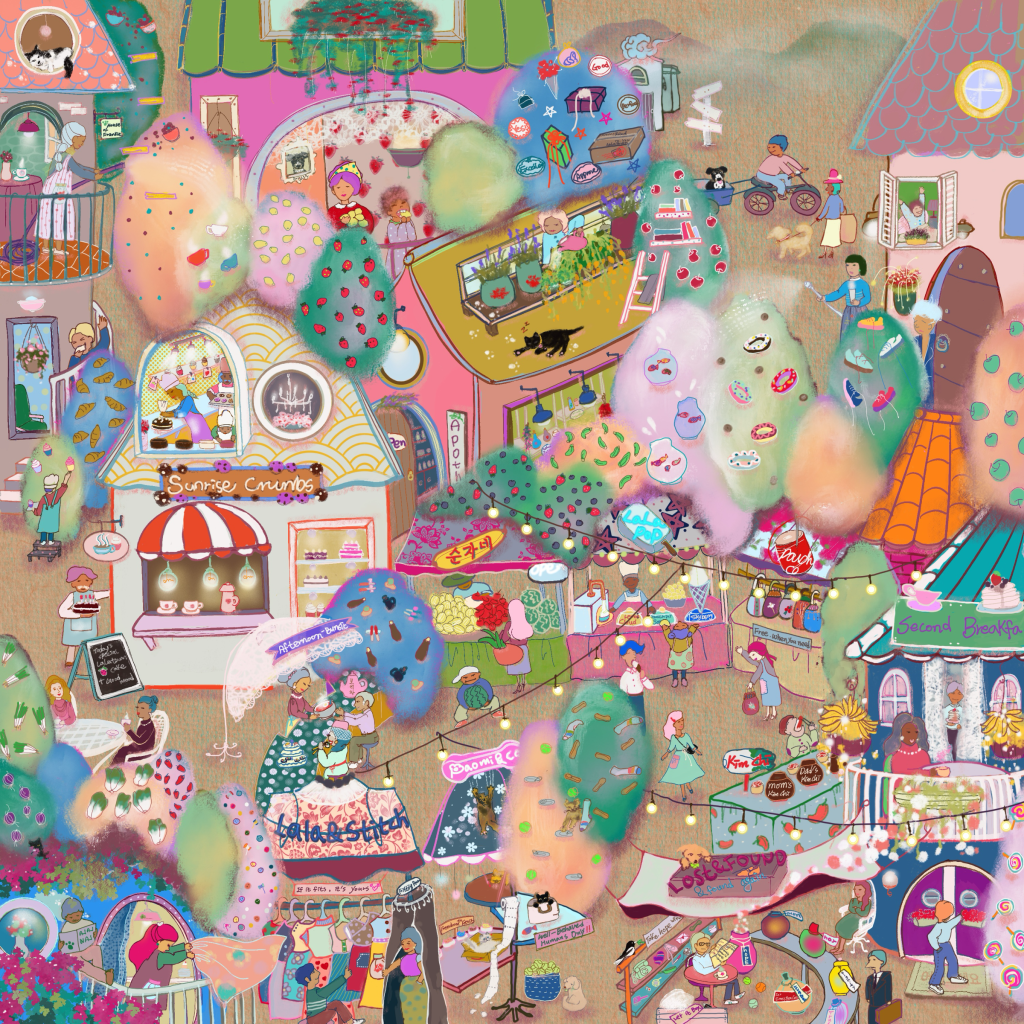
It grew while I was sitting by a hospital window, heating a warming pad for my dying mother in a shared microwave down the hall. Outside, the world was quiet. Rainy. Strangely calm. People walked by with umbrellas. Life continued at a pace that felt impossible to join. I remember looking out and painting what I later called A Sweet Dream of LALATOWN— not because I was happy, but because I wished I could be inside that view instead of just watching it from the other side of glass.
Inside the hospital, time didn’t belong to us.
Days were ruled by regulations, insurance approvals, and clocks that never slowed down for grief. Every day came with decisions that didn’t feel like real choices:
You may want to try this.
There’s no guarantee.
Less than ten percent.
If you refuse, she may have to leave this facility.
Even dying had a schedule.
In that endless loop of urgency — running out of the patient room to find a nurse, asking for more pain medication, waiting for test results, watching CT scans and X-rays happen because they were “allowed” — I began to miss the smallest, most ordinary things with an ache that surprised me.
Watering plants under strong sunlight.
Saying hello to strangers.
Eating a fresh strawberry without checking the time.
Having a cup of coffee without bracing for bad news.
Biting into a soft pastry or cake just because it looked good.
I missed the luxury of not thinking.
I missed making kimchi.
I missed the feeling of finishing a batch, knowing I could rest — knowing that for the next month and a half, at least one small part of life was taken care of. That kind of security felt enormous. Sacred, even.
I missed naps.
I missed walking my dog.
Feeding my cat.
Going to the farmers’ market and standing in front of vegetables with nowhere else I needed to be.
Those ordinary moments became my definition of happiness.
So I built a place where they were protected.
In LALATOWN, kindness is the currency.
No one rushes you.
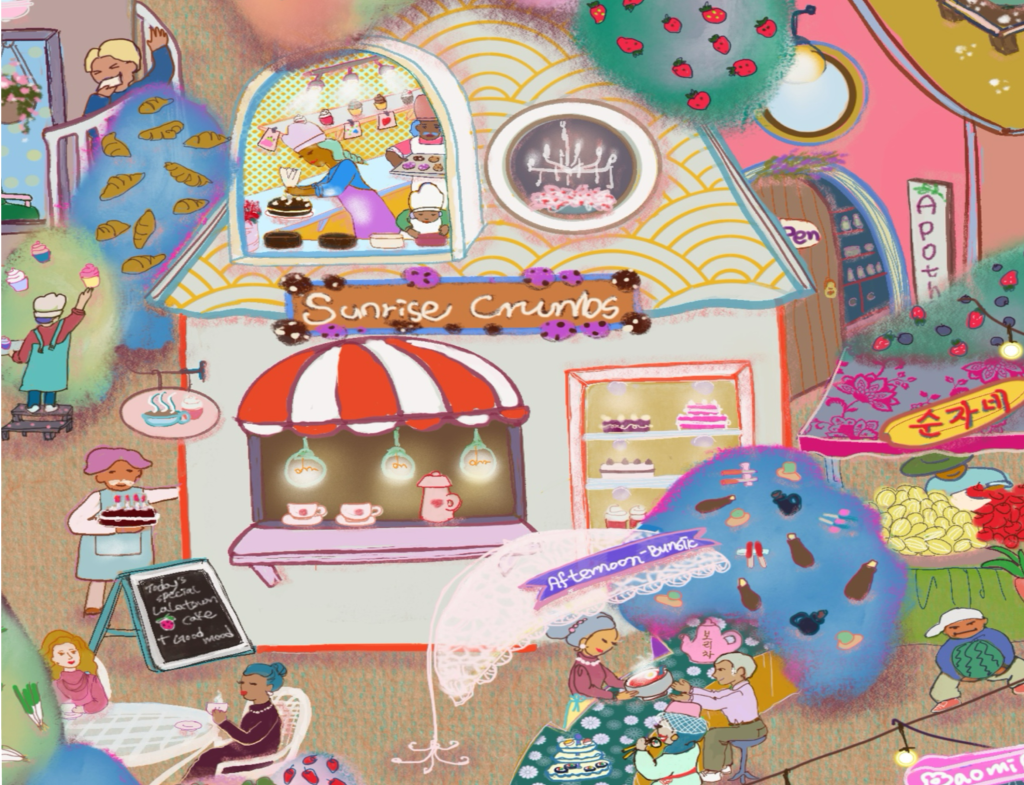
You can have three breakfasts if you want — and if your second breakfast happens at two in the afternoon, no one names it or questions it. There’s a lost and found, not just for objects, but for parts of yourself you thought were gone. People read books without proving anything. Colorful clothes exist simply because they make someone smile. Kimchi gets made. Naps are encouraged. Life happens gently.
LALATOWN Life exists because I needed a place where survival could soften into living again.
It’s not an escape from reality.
It’s a response to it.
A town built from desperation, memory, care, grocery aisles, hospital windows, and the deep understanding that ordinary life — the kind we forget to notice — is the most precious thing we have.
 LALATOWN LIFE
Leave a comment