Some memories don’t move forward with time.
Mine stayed in Seoul—somewhere around 1996.
People who leave their country often carry their memory like a snapshot. No matter how many times they return, it doesn’t fully update. Culture keeps moving, but the image you hold stays still.
It’s funny. People who moved to the United States in the 1970s sometimes preserved everything—language, manners, values, even the exact tone of life. It’s incredible, really. I didn’t do that. I lived here for three decades. So when I go back to Korea now, even though I speak Korean perfectly, I’m treated like an outsider. Not rudely—just culturally. I’m no longer inside the circle.
And that’s okay.
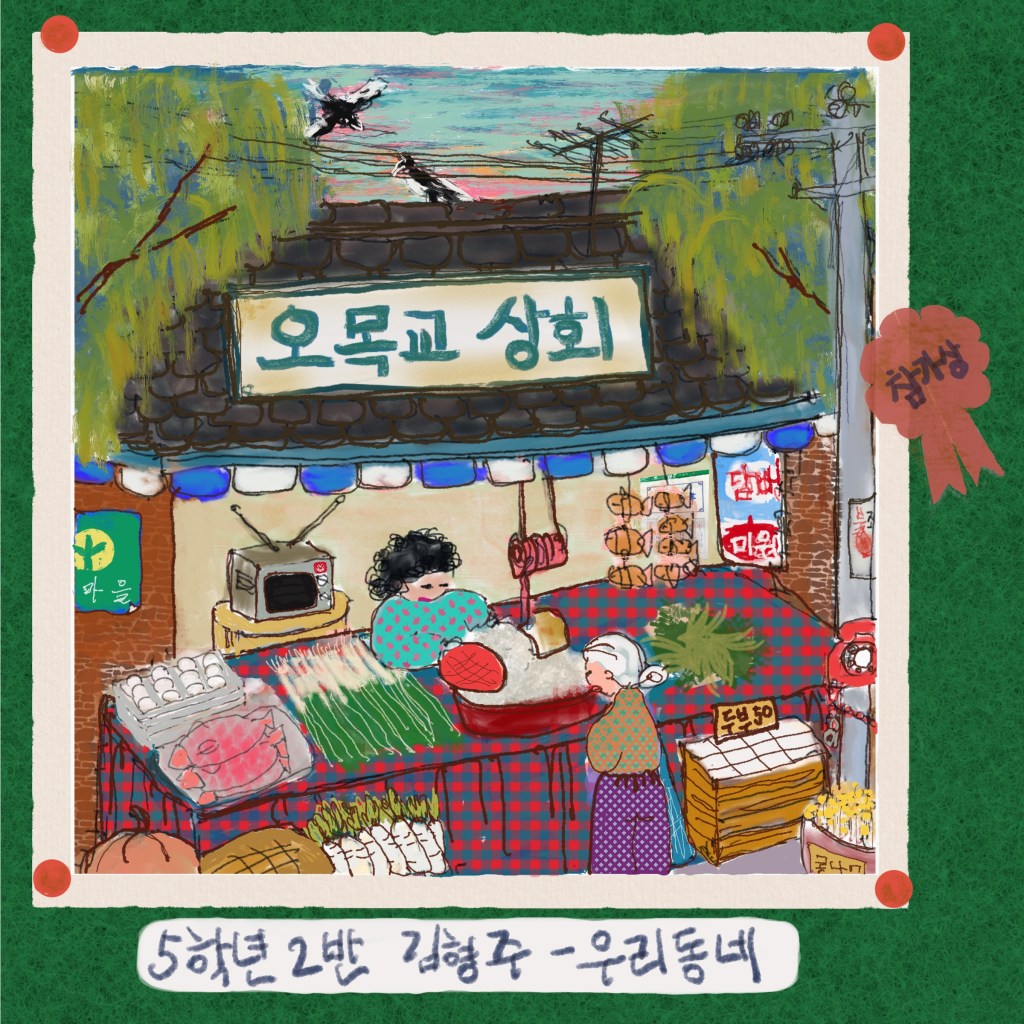
This painting comes from that place.
From the Seoul I grew up in during the 1970s and 80s. From the small corner grocery stores that sold everything—rice, cigarettes, candy, notebooks. There was usually a public phone. Sometimes a government poster on the wall. Sometimes a handwritten list behind the counter.
People didn’t always pay.
They said, “Put it on my tab.”
(외상.)
That was real life.
In elementary school art class, the assignment was always something like: Draw your town. I drew those streets. Those shops. That everyday chaos. But the prizes—the gold, silver, bronze—usually went to class leaders or kids whose parents donated more. I’m not bitter about it. I’m just honest.
So I gave myself a ribbon.
Not gold.
Not silver.
Not bronze.
A participation ribbon.
This one stays with me.
The paintings of nostalgia, the Self-Issued Participation Ribbon, and Eventually Everybody Came belong together. They’re not about nostalgia for its own sake. They’re about memory that no longer hurts. Memory that’s been gently wrapped, like a bandage.
Painting these scenes didn’t reopen anything. It closed something. It let me laugh at what once felt unfair. Not in a grand, heroic way—just in a human one.
This isn’t Da Vinci-level painting.
It’s memory painting.
And that was enough to build LALATOWN.
 LALATOWN LIFE
Leave a comment