When I was growing up, once upon a time in Seoul, Korea, holidays didn’t arrive quietly.
They arrived early. Loud. Hungry.
Preparations began days in advance. Sometimes a full week before. My aunt — my father’s older sister — would come early and start rendering lard from pork fat. Real lard. Grocery deliveries weren’t a thing. Everything had to be bought, carried, prepared by hand. Fruits were counted carefully, especially the ones meant for memorial services. And once the holiday started, the only rule was this: eat, eat, eat, eat.
Everybody came.
Not all at once. Never all at once.
Relatives appeared from nowhere — my grandmother’s younger brother’s son, then another son, then another. Each arrival triggered a reset. The women would quietly clear the table and prepare it again. It had to look untouched. Clean. Fresh. No trace of leftovers.
Japchae could not be missing.
The meat soup could not be missing.
Galbitang could not be missing.
Bulgogi could not be missing.
And the jeon — the Korean pancakes — had to be reheated just right. Always warm. Always crisp. Hundreds of them.
That was the holiday.
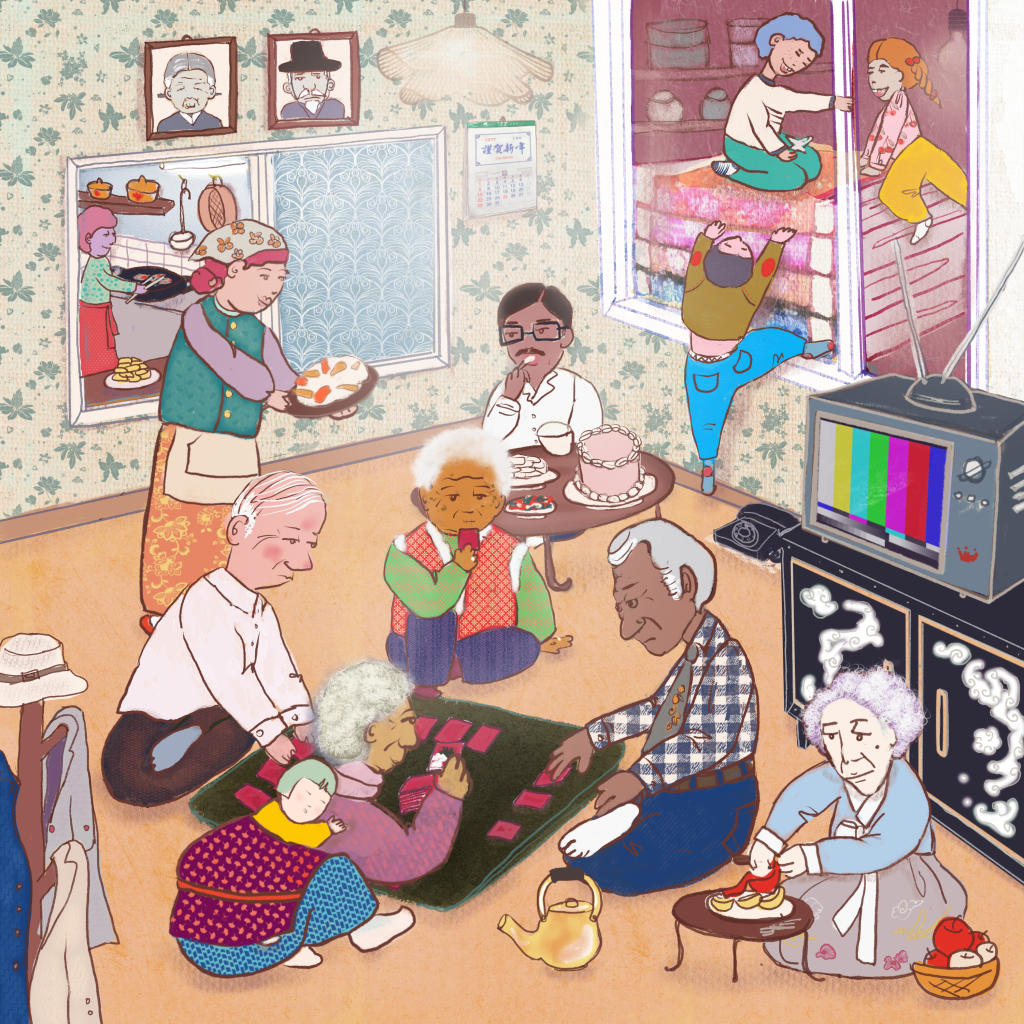
The elders sat in the main room, playing hwatu. Only the respected ones — older women, older men, and maybe the head of the household like my father. Helping in the kitchen? No. Absolutely not. That was women’s work. Full stop.
The children?
There was no such thing as child safety.
We crawled into the loft, rolled around in stacks of futons, fell, bumped, cut ourselves. Worst case? You got stitches. I still carry the evidence on my face. No one panicked. That was just how it was.
The television and the telephone sat like sacred objects — symbols of wealth. And the hierarchy among women was strict and visible. First wives ate in the main room. Second wives — even if they were the current wives, even if they had more children — stayed in the kitchen. My mother, being at the bottom of the ranking, ate there too. Not at the same table. Never the same table.
Crazy?
Yes. Completely.
Bananas — whole bunches — sat on the table like treasure. At the time, bananas weren’t properly imported. One bunch could cost a month’s salary for a factory worker. They weren’t snacks. They were statements.
The men smoked. Constantly. Babies were everywhere. No one cared.
There were glass jars of honey. Snake alcohol. Sewing baskets filled with needles and thread. Looking back now, I think: every adult in this room would be arrested today.
Ancestor portraits hung in odd places. Clotheslines existed only for the respected elders’ clothes — no one else’s. Tables were reset every hour. There was no “joining late.” A master’s-degree uncle arrived from the library carrying a briefcase — unnecessary, theatrical — and immediately another table was prepared just for him. Male. Educated. Important.
My grandmother watched everything like a general.
“Why is there so little galbi?”
“Bring more.”
Mandu — dumplings — were made a week in advance. This was child labor disguised as folklore. We were told, If you make pretty mandu, you’ll have a beautiful daughter. I believed it. I worked hard. (I never had a child. So much for that promise.)
We squeezed tofu and bean sprouts through cheesecloth until no liquid remained. Refrigerators were packed. Freezers were white with frost. Extra mandu were stored outside in stacked flat baskets, layered with cloth. For months afterward, dumplings appeared everywhere — dumpling soup, dumplings in kimchi jjigae, dumplings in everything.
Do I eat dumplings now? Yes.
Do I ever miss them? No.
The jeon — maybe five hundred of them — were frozen, reheated, topped with crispy bits left over from rendering lard. Bacon-like. Salty. Unforgettable.
And through all of it — the abundance, the hierarchy, the absurdity — emotions ran high. Hwatu games turned intense. Money wasn’t the point; it was the feeling. Accusations flew. Old resentments surfaced. I still remember hearing things like, Without me, you’d be in jail. You’d be on the street.
Logic had no role.
It was pure emotion.
Everybody came. Everybody ate. Everybody left — and the hierarchy stayed exactly where it was.
 LALATOWN LIFE
Leave a comment