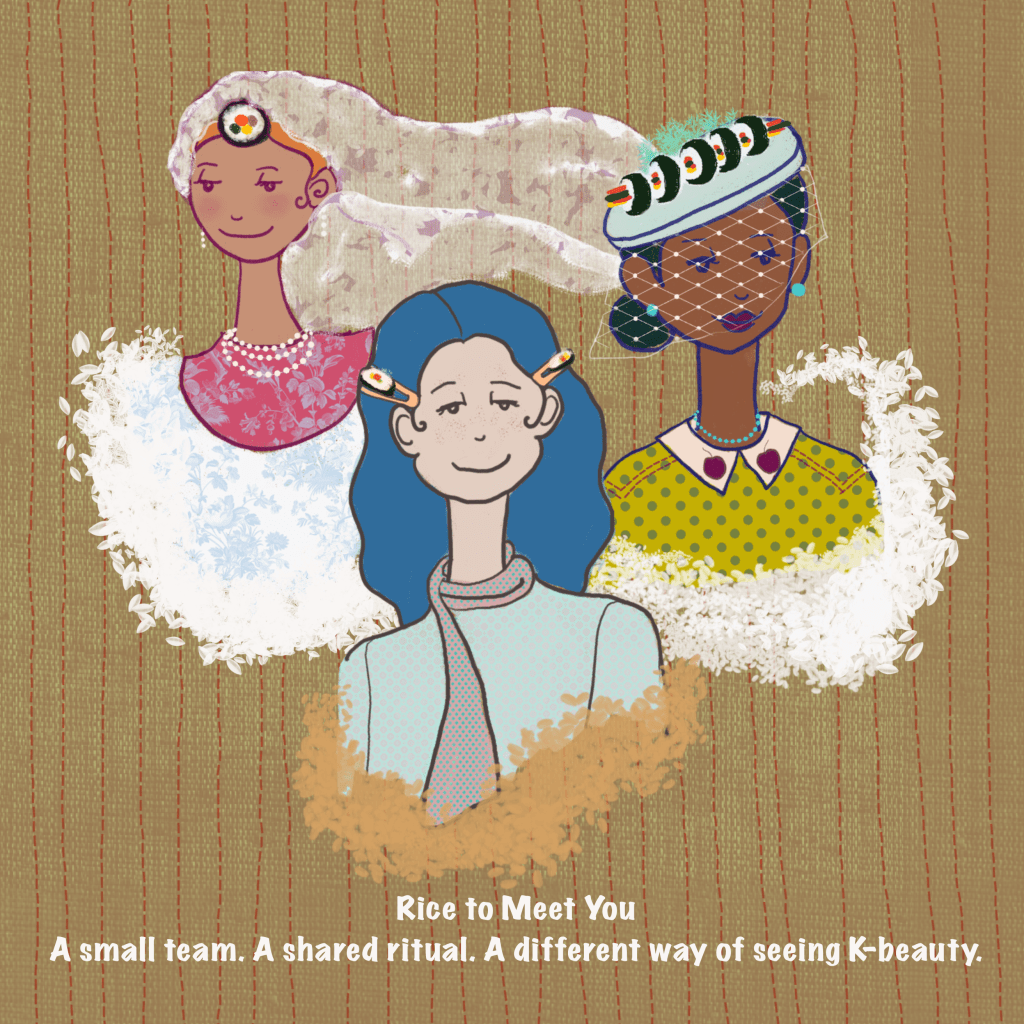
Three friends, a bowl of care, and the quiet rituals behind K-beauty.
Everybody is talking about K-beauty.
Every social platform. Every before-and-after.
How good it is. How impressive it is. How suddenly everything looks very… hydrated.
I moved to the U.S. a long time ago, but I still go back to Korea. I meet my friends—women in their mid-50s—and I see what’s actually going on. Not the internet version. Real life. Real faces. Real routines.
I know the routines.
I know the treatments.
And yes, I buy a lot of K-beauty products.
I mean, a lot.
So here’s the truth about K-beauty.
First, people think K-beauty means made in Korea.
That’s not quite right.
K-beauty isn’t about one miracle cream. It’s about how products are used—slowly, deliberately, in layers. There is never just one moisturizer. Skin care is stacked, little by little. That’s how glass skin is made.
Vitamin C alone? Not really.
Retinol alone? Also not really.
There is always something underneath—hydration, barrier care, essence—and something on top. Moisturizer layered once, twice, sometimes three times. Mixed with this. Balanced with that. Absorption matters more than strength. Otherwise, makeup just sits there, slightly confused.
We’ve all seen it.
And here’s something people don’t love to admit.
Some of the most trusted products dermatologists rely on in Korea are not Korean brands at all. People use them consistently because they calm irritation and repair the skin barrier. They work.
Barrier first.
Everything else comes later.
Another truth about K-beauty has nothing to do with creams.
It’s the healthcare system.
In Korea, people go to dermatologists easily. They don’t just get prescriptions—they get treatment. Milia, clogged pores, tiny cysts—those things are treated immediately.
When people say it’s “cheap,” this is what they mean:
Each individual laser shot for a small milia costs very little—often under ten dollars per shot. But almost no one has just one. Most people discover they have many—without realizing it.
So yes, it adds up. But it’s still accessible. And because it’s accessible, people don’t wait.
That’s why you see people everywhere—with small recovery bandages on their faces. On the street. On the subway. At the airport. No one stares. It’s normal. You shower, you live your life, and the bandage falls off by itself.
That kind of access changes everything.
Yes, people also use cosmetic treatments—Botox, lifting treatments, skin boosters. I call them treatments, not surgery. They’re not covered by insurance, but they’re common enough to be part of regular maintenance.
Of course things go wrong sometimes.
That happens too.
And when it does, there’s no rewind button. That’s just reality.
So here’s the thing.
There is no such thing as natural beauty.
There just isn’t.
Beauty is layered. Mixed. Maintained. Repeated.
Layer after layer. Care after care.
And cleansing? That part is not optional.
You cannot remove makeup with one step. You just can’t.
Not if you have visible pores. Not if you’re not nine years old with untouched skin.
Double cleansing is mandatory.
I strongly prefer oil cleansing—especially oil cleansers that emulsify into foam in one step. And yes, even sunscreen needs to be removed at night.
In Korea, sunscreen is everywhere. It’s in almost every product. Cushions, foundations—everything contains it. And those cushion foundations? The rest of the world still hasn’t fully caught on, but Koreans love them for a reason.
They don’t look like foundation.
They give glow.
Coverage comes from concealer, not the cushion. That’s the rule. If you want that “your skin just looks good” look, that’s how it’s done.
About cushion foundations (정샘물)
Cushion foundations are not meant to behave like traditional foundation. They’re not there to cover everything. They’re there to even things out, add glow, and let skin look like skin.
Coverage comes later—from concealer.
The cushion sets the mood.
I’ve tried many cushions. I leave this one, experiment, everything seems fine—and then, a year later, I buy it again. Every time.
That one is:
JUNG SAEM MOOL Essential Skin Nuder Cushion Foundation (SPF 50+)
If you’re looking for drama, this isn’t it.
If you’re looking for “this still looks like my skin,” this is it.
My non-negotiables
These are the basics I always come back to. If I run out, I replace them immediately—no debating, no experimenting.
- ROUND LAB Birch Juice Moisturizing Toner (300 ml)
- AESTURA Atobarrier 365 Cream
- La Roche-Posay Cicaplast Baume B5
They’re easy to find at Amazon or Target, and the prices are usually similar. If you need it fast, Amazon tends to be the quickest.
Retinol can irritate the skin badly. Sometimes you don’t have a choice. When milia shows up, treatment becomes unavoidable. That’s just how it is.
People age.
Even with good care, they age.
A woman in her 50s who takes care of herself looks like a well-taken-care-of woman in her 50s.
A woman in her 60s looks like a well-taken-care-of woman in her 60s.
Maybe ten years younger. Maybe.
And that’s normal.
So yes—when I go back to Korea, I’ll get treatment.
Care is routine.
Access is normal.
Maintenance is part of daily life.
Somewhere between layering moisturizer, cleansing properly, and accepting that age is age, you end up with skin that looks like it’s been treated kindly.
That’s K-beauty.
Happy K-beauty.
 LALATOWN LIFE
Leave a comment