Growing up in Korea, bunsik was simply part of my everyday life.
On picnic days, my mom would roll dozens of kimbap.
We didn’t even slice them properly.
We would grab them whole and bite into them—just like my dad did.
Trying to follow him.
Sometimes the spinach would fall out all at once.
Sometimes the meat would drop to the ground.
But picnic day was always… kimbap day.
Korean people love kimbap.
Deeply.
Some people confuse it with sushi, but it’s completely different.
Kimbap was almost a competition.
Which mom made it best?
Funny thing is—
you could see everything in that kimbap.
The care, the personality,
how organized the mom was,
how neatly everything was packed inside
without bursting.
And inside the lunch bag—Fanta.
I still remember that taste.
Taking a bite of kimbap,
then a sip of Fanta—
that sparkling moment inside my stomach.
Even now, when I see Fanta,
I still buy it sometimes.
It feels like someone squeezed an orange just for me.
That’s how we grew up.
Then one day, Korea had places like
“Kimbap Heaven.”
No need for moms to struggle rolling dozens anymore.
You could just order.
2,000 won a roll.
Sometimes even 1,000.
That was when I had already moved to the U.S.
And somehow…
I stopped eating my mom’s kimbap.
Because it was everywhere.
Even luxury versions started appearing.
Department stores, underground food halls—
beautiful, delicious kimbap.
A few pieces for 5,000–6,000 won.
About $3.50.
Unbelievable, but real.
That’s why bunsik is something
Koreans can never separate from.
And then… the street stalls.
The lady with the red rubber gloves.
Someone in front of me orders tteokbokki,
and I swallow my saliva.
Please don’t take it all.
Please.
Because if it’s gone,
I have to wait another 20–30 minutes
for the next batch to slowly simmer.
My heart burns waiting.
But of course,
they order everything.
So I get sundae first.
Maybe some fried snacks.
And somehow,
the lady knows.
She keeps pouring fish cake soup for me.
That salty, MSG-filled broth.
But back then,
I truly believed it was something
deeply boiled and special.
Dipping fish cake into soy sauce,
taking a bite—
something in the day just completes.
We all spilled things.
And somehow,
tteokbokki sauce always landed
on a white blouse.
Rolling.
Leaving a stain that could never be just “one drop.”
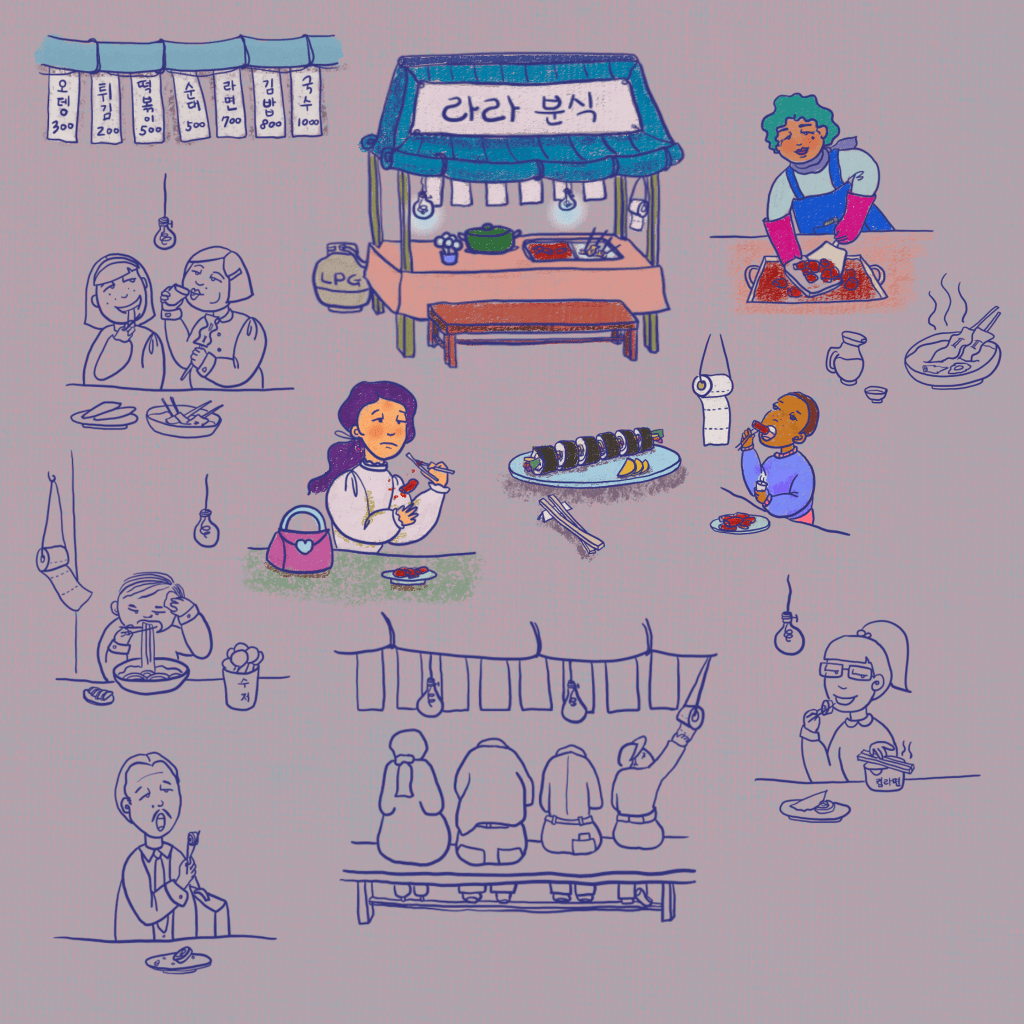
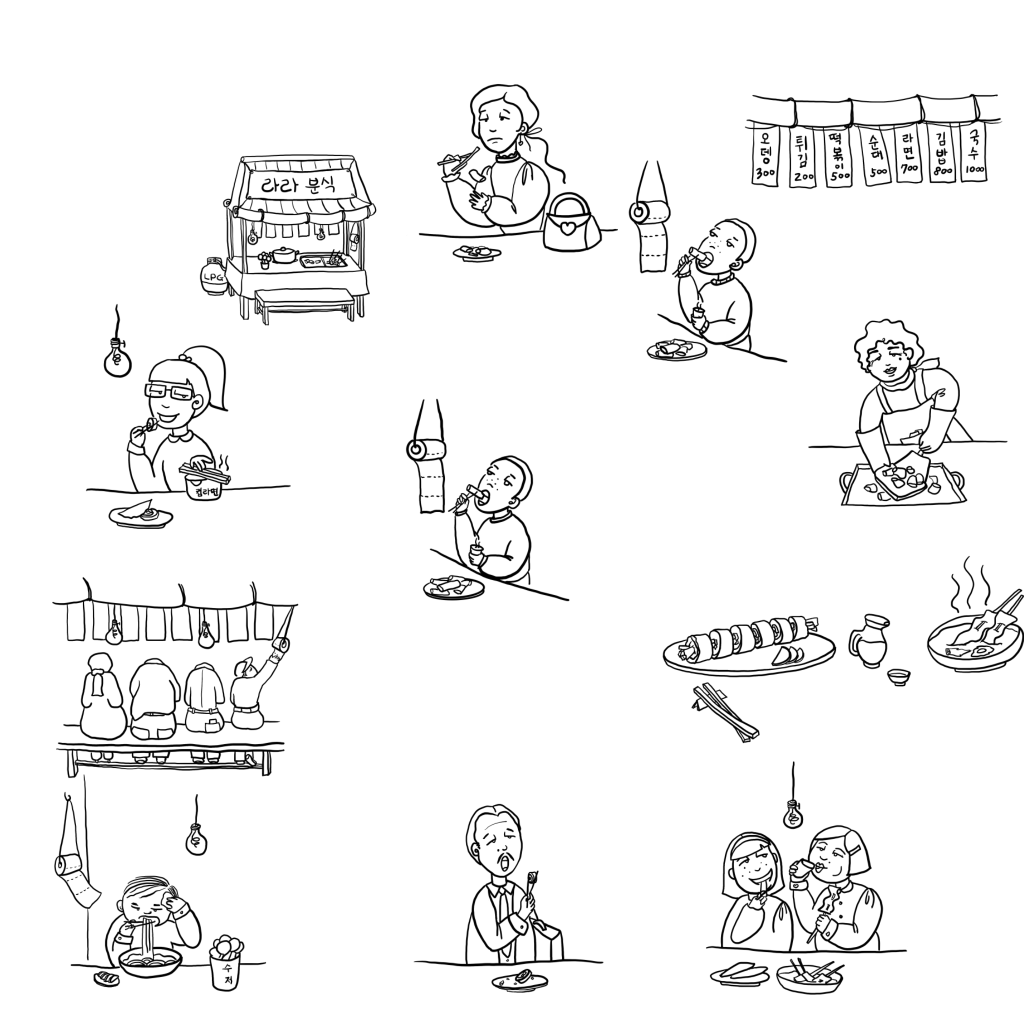
So I turned all of these into stamps.
Using Procreate,
I made bunsik stamp brushes.
Even the tiny details—
like the toilet paper hanging there,
not tissues,
just plain bathroom rolls.
The light bulb above.
The casually sliced kimbap.
The free kimchi—because back then,
you couldn’t run a business without giving kimchi.
Eating with friends,
dipping fried snacks into that sauce,
not even caring who sat next to you.
Sometimes you spilled on them.
Sometimes they spilled on you.
But no one got that angry.
And then at night,
when my mom asked if I wanted dinner,
I would just poke at the food.
“You ate outside, didn’t you?”
“No… I didn’t.”
But I did.
Tteokbokki.
Fish cake.
Bunsik.
I made this process into a video
and uploaded it on Pinterest and YouTube.
If you want to see it,
go to the main page and click the logo—
it will take you there.
This was fun to make.
I thought hanbok was fun,
but bunsik was even more fun.
Welcome to LALATOWN life.
And thank you for listening to my story.
 LALATOWN LIFE
Leave a comment