Almost every painting I have ever made has a waterfall in it.
My oil paintings have waterfalls.
My watercolors have waterfalls.
But until now, I don’t think LALATOWN had one.
With this illustration, I finally felt able to bring many of the skills I have gathered over the years into one digital world. It took a long time. Much longer than I expected. But I could not give up on this Procreate illustration.
Digital drawing gives me an endless table full of materials. Paint, paper, ink, texture, architecture, people, food, memory—everything can meet in one place.
Nearly two-thirds of this illustration was created using Procreate brushes I have already made for LALATOWN. Many of the new characters and objects born inside this picture will also return as future brush sets.
That thought makes me breathe a little easier.
At first, I was simply going to draw Bukchon.
Bukchon is one of Seoul’s most famous traditional neighborhoods, and I still enjoy it every time I visit. It feels strangely storybook-like without becoming childish. Traditional architecture, handmade jewelry, fabric, ceramics, clothing, cafés, tiny shops—there is always something to discover.
Honestly, Seoul is extraordinary that way. Dongdaemun, Cheonggyecheon, Bukchon, and Insadong can all feel connected by walking.
But summer in Seoul is hot.
How hot?
Hotter than whatever you are imagining.
And into this very warm Bukchon, several new residents moved into LALATOWN.
They brought grilled pork belly, garlic scapes, green onion salad, and homemade food to share.
The green onion salad must have made a particularly deep impression on me. Its scent stayed in my mouth for four or five days, no matter how thoroughly I brushed my teeth.
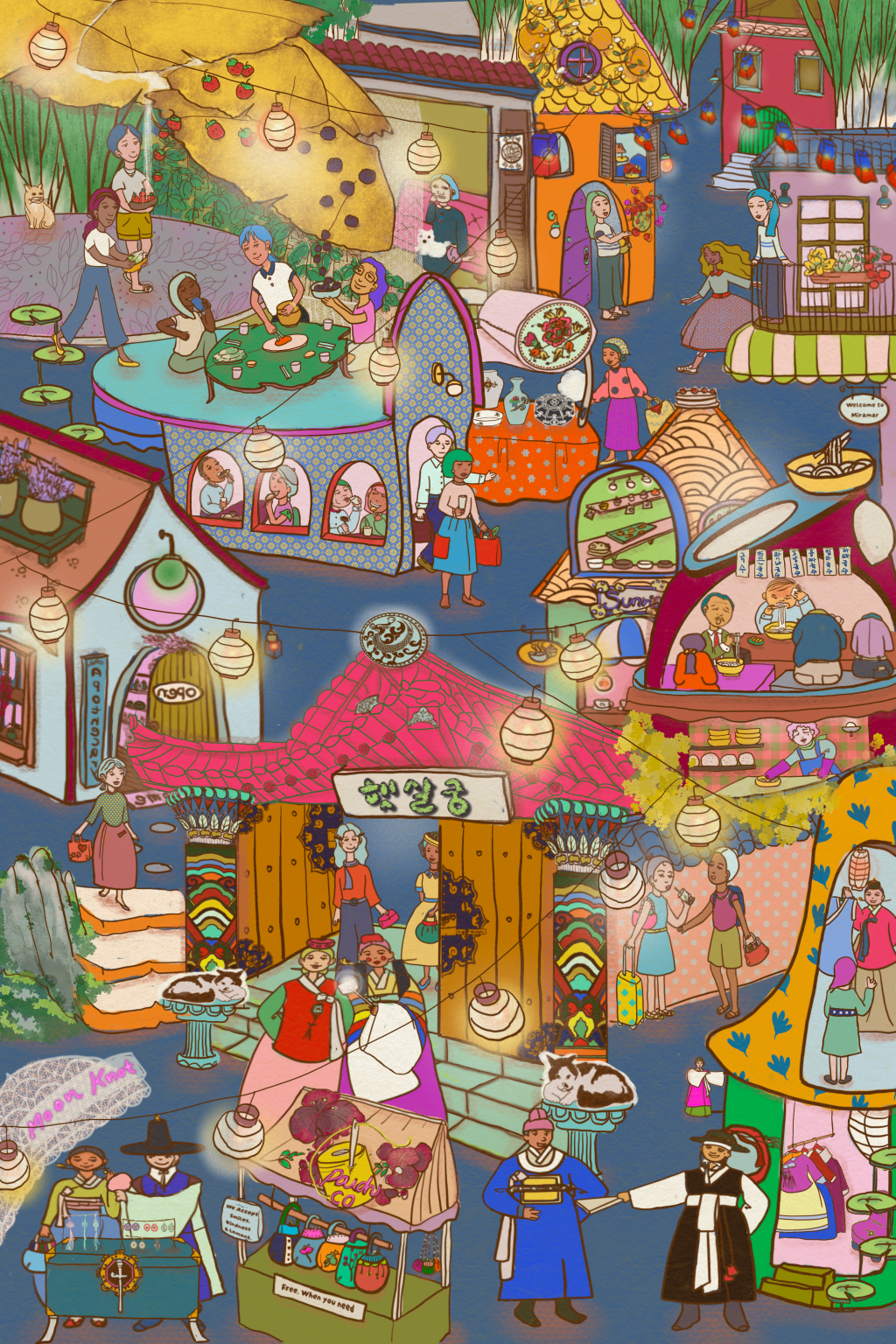
So naturally, I created green onion trees.
Why must a forest be filled only with conventionally beautiful trees?
Why not a forest of scallions?
Then I began wondering why a table had to look like a table. Why couldn’t it be shaped like a perilla leaf?
And if someone suddenly wanted strawberries or blueberries, why couldn’t enormous ginkgo leaves become parasols and offer fruit from underneath?
In LALATOWN, they can.
Sometimes a spring suddenly appears nearby, so everyone can wash what they have picked. This is especially useful for the Korean residents of LALATOWN, who take washing vegetables very seriously.
Naturally, Haetsalgung has an object honoring Frankie.
But no one in LALATOWN chips away at stone to create statues.
Frankie refused.
He said no one should have to spend their days striking stone on his behalf.
So the monument at Haetsalgung is made of paper instead.
There is even a rumor that visitors sometimes leave small Post-it notes on it—little messages they wish they could send to Frankie.
The noodle shop came from my memory of eating wonderful noodles in Bukchon. Its sign is not written in ordinary letters. It is shaped like noodles being lifted by chopsticks.
There are winding stairs inspired by lotus leaves, and beside Haetsalgung, there are steps made of sliced bread.
Frankie asked, “Who decided stairs have to be made of stone?”
Everyone agreed.
And so the bread stairs were built with one hundred percent approval.
Bukhansan is beautiful, but climbing it is not easy. So LALATOWN created a small version of its dramatic peaks at human height, where everyone can enjoy the view without exhausting their knees.
The accessory shop, pottery shop, and fabric shop have no owners standing behind counters.
People may look around and take what they truly need.
Payment is simple: a kind compliment, a note saying something is beautiful, or perhaps a lemon.
That is enough in LALATOWN.
The longer you look around this picture, the more stories begin to appear.
A new Korean neighbor I recently met brought us plums and a beautiful yellow watermelon. The plums were so delicious that I bought more afterward.
The yellow watermelon was so lovely that I began calling her the Lady of the Yellow Watermelon House.
Now yellow watermelon vines grow across her roof, and plums appear among the hanging flowers.
Across the way is another young woman who wanted very much to join everyone but could not because of severe morning sickness.
Her heart was already at the gathering, even when her body could not be.
So I placed her on the balcony like Romeo looking down from a scene in Romeo and Juliet, watching the life of the neighborhood from above.
There is the friend who washed the lettuce.
The friend who turned the meat on the grill.
The friend who loves blueberries.
The friend catching blueberries in a basket.
And one more resident was scouted from my Korean Town brush set and invited to sit among them.
This is how LALATOWN continues to grow.
In a way, I believe these places and stories were already there. I simply keep the small treasures I encounter—people, food, kindness, strange ideas, funny memories—and carry them back with me.
Then I draw them so they do not disappear.
I am not trying to turn them into legends.
I want to say that places like this can exist. Kindness like this can exist. A neighborhood can be built from food, memory, generosity, paper monuments, scallion forests, and bread stairs.
I suppose that is what I am becoming:
a storytelling illustrator who gathers real moments, carries them into LALATOWN, and shares them through pictures.
So, shall we take a slow walk through LALATOWN together?
There are two ways to visit this neighborhood:
☀️ This Is How LALATOWN Lives
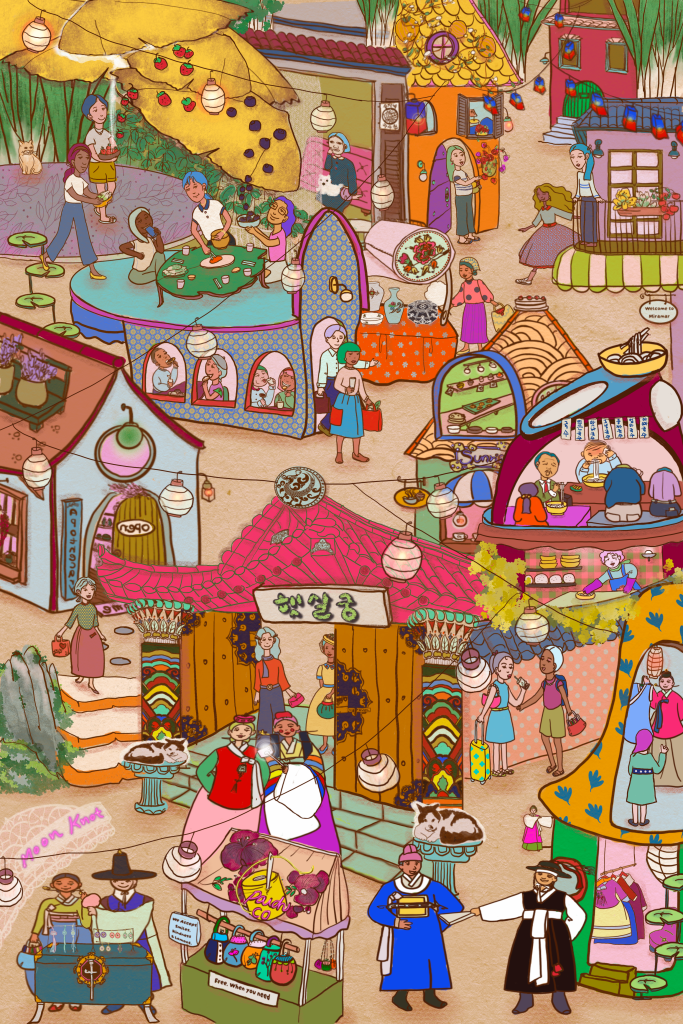
when the streets are bright, busy, and full of everyday life.
🌙 This Is How LALATOWN Glows
when the lanterns come on and every little window begins telling another story.
 LALATOWN LIFE
Leave a comment