I don’t like it when people tell me they’re sorry.
I really don’t.
At this point in my life, I think I would rather have relationships where, at the end of the day, we can simply say:
Thank you.
Maybe that sounds strange. But I have my reasons.
Some of the people who hurt me most knew they were hurting me. And strangely, those were often the same people who needed the most from me, demanded the most from me, and held on to me the hardest.
I don’t want to spend much time telling those stories anymore.
Two members of my family, at the very end of their lives, came out of unconsciousness and apologized to me.
One of them apologized for things that happened when I was still a child.
The other was my mother.
I sometimes wonder how much regret a person must carry to wake up at the edge of death and say, I’m sorry.
But this is not a story about them.
Something rather unexpected has been happening to me lately.
As I have slowly learned to forgive myself, I have begun to remember all the people I am grateful for.
And there were so many.
The little art school
I think I was near the end of fifth grade when I asked my mother if I could go to art school.
We couldn’t afford one of those serious, expensive art academies, so I went to a tiny neighborhood art school attached to a kindergarten.
I was already too old for the place.
The tables and chairs were made for little children. I must have looked ridiculous sitting there.
On my second day, someone told me there was an art competition coming up and that I needed poster paints.
So I went to the neighborhood stationery store, bought some cheap poster paints, and painted whatever I felt like painting.
The director entered my picture in the competition.
I won the Gold Prize in a national competition.
There was one Grand Prize above mine, so technically I came in second in the country.
My mother asked what I wanted as a reward.
I asked for a perm.
Not even a whole perm. Just my bangs.
At the time, perfectly straight hair was apparently a tragedy that needed immediate correction, and curled bangs were terribly fashionable among Korean girls.
I went to receive my national art prize with my newly permed bangs.
There are photographs somewhere.
I hope humanity never finds them.
But something much more important happened at that tiny art school.
There was a young teacher there who normally taught kindergarteners and first graders.
For some reason, she became curious about me.
She started giving me things to try.
Watercolor. Color exercises. Shapes divided into sections. Circles divided into planes. Strange little assignments I didn’t understand.
I simply did whatever she gave me.
I entered more competitions after that and usually won something, although I never again managed anything quite as spectacular as second place nationally.
Then, a few months later, that teacher took me and another girl I was close to into Seoul.
She took us to Insadong, which is now an internationally known tourist district, but to me then it was a place filled with galleries.
She bought us tteokbokki.
Maybe this explains my lifelong devotion to tteokbokki.
When it was time to go home, she walked us to the bus.
And before I got on, she said something to me.
“I believe that someday I will see your paintings here in Insadong. Don’t give up drawing.”
The next day, she was gone.
She had left the art school.
Then life got complicated
My family entered years of illness.
My grandparents became very sick. Money became tighter and tighter.
I remember going to school exhausted because I had been awake at night helping care for my grandmother.
I was still good at drawing.
Whenever our school went to Gyeongbokgung or Changgyeonggung for outdoor painting competitions, my work would be among the pieces considered for prizes.
In middle school, one of my teachers—who was also an art teacher—called me aside and asked whether my family could afford to send me to a serious art academy.
I asked my mother.
We couldn’t.
Those academies were expensive.
And after that, something changed.
I wasn’t even allowed to join the casual school art club because, I was told, my drawings would discourage the other children.
So for years, art mostly disappeared from my life.
When my grandmother died during my second year of high school, our circumstances finally changed enough that I could attend a proper art academy.
There was one problem.
I had only about nine months left before the university entrance exams.
Nine months.
I didn’t have years to develop traditional painting techniques, so design became the realistic path available to me.
At the academy, one of my instructors was a university student named Mr. Yoon. He was only about two years older than I was.
One day, while I was working on an assignment, he suddenly became furious with me.
He demanded to know where I had been taking private lessons.
I had no idea what he was talking about.
He accused me of secretly studying somewhere else and then coming into his class pretending to be some kind of genius.
I told him the truth.
I hadn’t had private lessons.
I hadn’t even been able to attend an art academy because my grandmother had been sick and my family couldn’t afford it.
This was my first chance.
His face turned red.
Then something extraordinary happened.
He went and talked quietly with the other instructors.
They came back to me with a proposal.
The academy was closed on Sundays.
But they would take turns coming in on Sundays, one teacher at a time, to teach me the fundamentals I had missed.
And they did.
Every one of them kept that promise.
Those young teachers gave up their Sundays for a girl who had arrived with nine months left on the clock.
That year, I got into art school.
Years later, I happened to discover that one of those teachers had become a university professor of art.
I was ridiculously happy for him.
And then I discovered something
During my first year at university, studying craft design, we took foundation courses—color, illustration, composition, all the things art students are supposed to learn.
One day, a professor gave us an assignment.
I did it.
The professor was astonished by my work.
I received an A+.
And I suddenly realized:
I had done this before.
Those strange exercises with divided shapes and circles and color that the young teacher at the tiny kindergarten art school had given me when I was twelve?
This was essentially the same kind of foundational design training.
I believe it may have been based on Bauhaus exercises, though my memory of the exact method is fuzzy now.
That teacher hadn’t simply been keeping a child busy.
She had been testing me.
She had been asking:
How far can this child go?
And without knowing it, I had carried those lessons with me for years.
They were still there when a young instructor later became angry because he couldn’t understand how a girl with no formal training already knew things he was preparing to teach her.
They were still there when I entered university.
And apparently, they are still here.
Because look at me now.
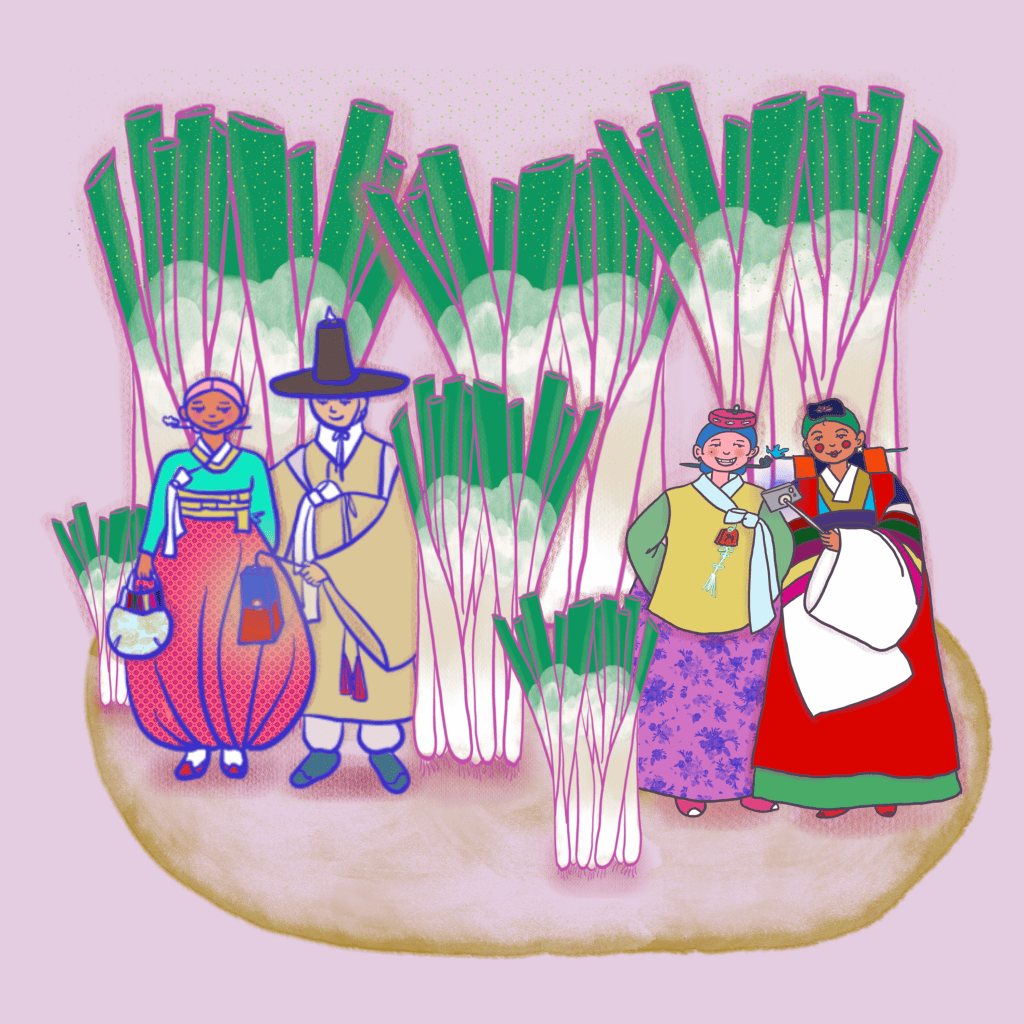
I draw a place called The Green Onion Forest on Potato Hill.
There are enormous green onions growing out of a potato-colored hill.
People in hanbok wander among them. Someone takes a selfie. Someone carries a traditional lantern.
This is what makes me happy.
I draw.
I write.
I make ridiculous little worlds.
And somewhere underneath all of them are the hands of people who taught a child something, encouraged her, gave up a Sunday for her, bought her tteokbokki, or stood beside a bus in Insadong and told her not to stop drawing.
They probably had no idea what those small acts would become.
This year has contained its share of disappointments and betrayals.
But strangely, as I have learned to forgive myself, I find myself thinking less about the people who hurt me and more about the people who were kind to me.
The people who gave me courage.
The people who gave me hope.
The people who quietly laid the foundation that eventually allowed me to find the thing that makes me happiest.
So I think I am finished collecting apologies.
I would rather spend the rest of my life collecting thank-yous.
And to those people, wherever they are now:
Thank you.
I did not give up drawing.
Thank you for helping me grow, long before LALATOWN even had a name.
In ways you may never have known, you helped me build this little world.
And wherever you are today, you will always have a place here.
You are forever a citizen of LALATOWN.
 LALATOWN LIFE
Leave a comment